In Fedena an Institution can be classified into Higher Education (Colleges and Universities) and K-12 Education. A Course is the study of a particular topic in an institution which when completed, qualifies the student to be a graduate and a Batch is a group of students who complete a specific course over a period of time through different sections/terms/semesters.
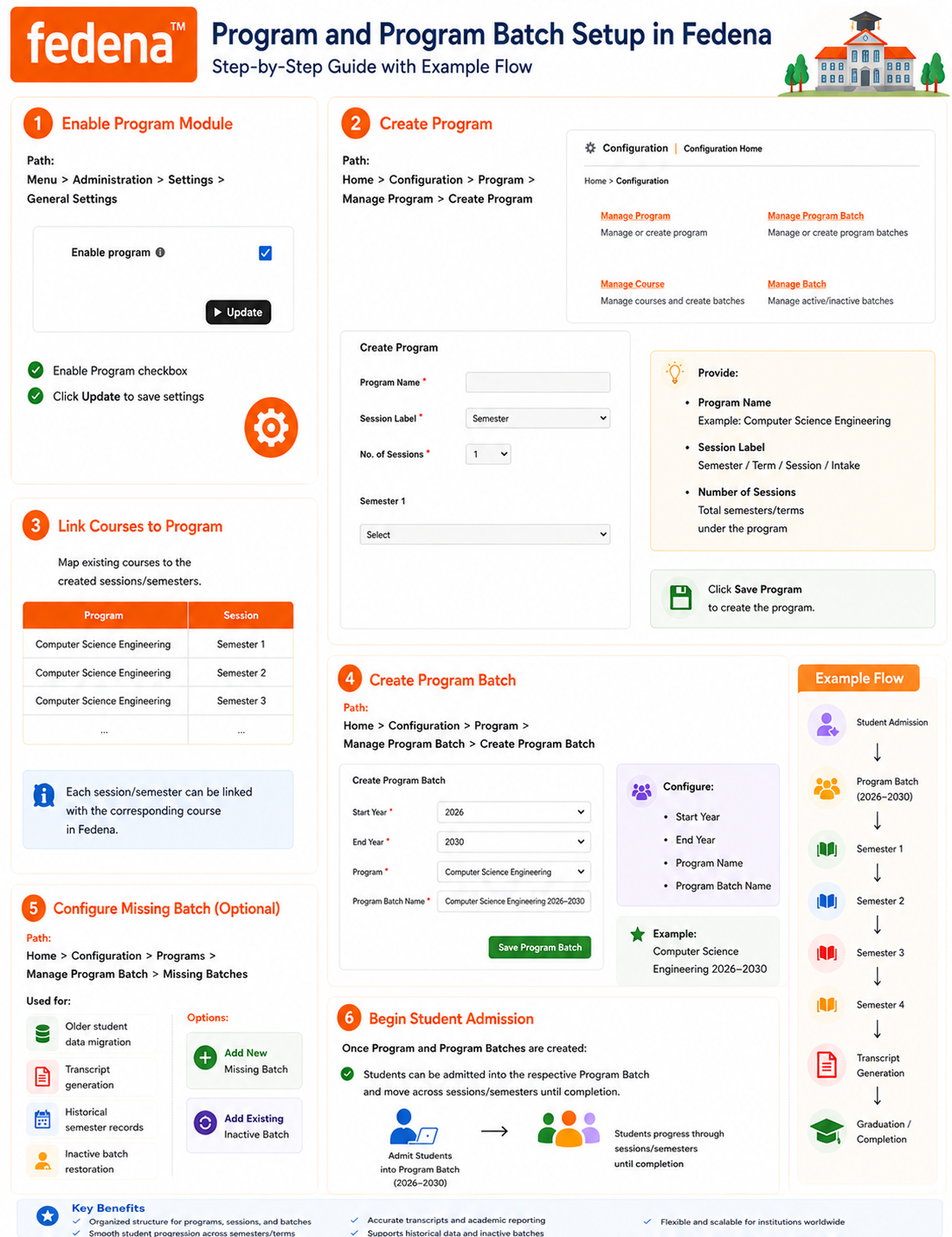
Universities and Colleges – Course and Batch Structure
Educational institutions across different countries and regions may follow different academic structures and terminology. However, the overall workflow for managing academic programs remains similar in most universities and colleges.
Institutions generally offer multiple Courses/Programs such as Undergraduate, Postgraduate, Diploma, Certificate, or Professional programs. Each course or program is further divided into different academic periods, which may be referred to as:
- Semester
- Term
- Trimester
- Intake
- Module
- Session
- Academic Level
Every academic cycle, a new group of students is admitted into the institution. This group of students is commonly referred to as a Batch, Cohort, Intake, or Section, depending on the institution's terminology.
Students generally begin their academic journey from the initial level or period of the program and progress through the subsequent academic stages upon successful completion of the required assessments or academic criteria.
For example:
- A student may join Bachelor of Science – Intake 2026 and progress through Semester 1, Semester 2, Semester 3, and so on.
- Another institution may follow Term 1, Term 2, and Term 3 instead of semesters.
- Some institutions may use Year 1, Year 2, Year 3, or Level 1, Level 2, Level 3 structures.
Once students complete all required academic periods and satisfy the institution's graduation or completion requirements, they become eligible for course completion, certification, or graduation.
This flexible structure allows institutions globally to configure their academic setup according to their educational system and operational requirements.
K–12 Education – Class and Section Structure
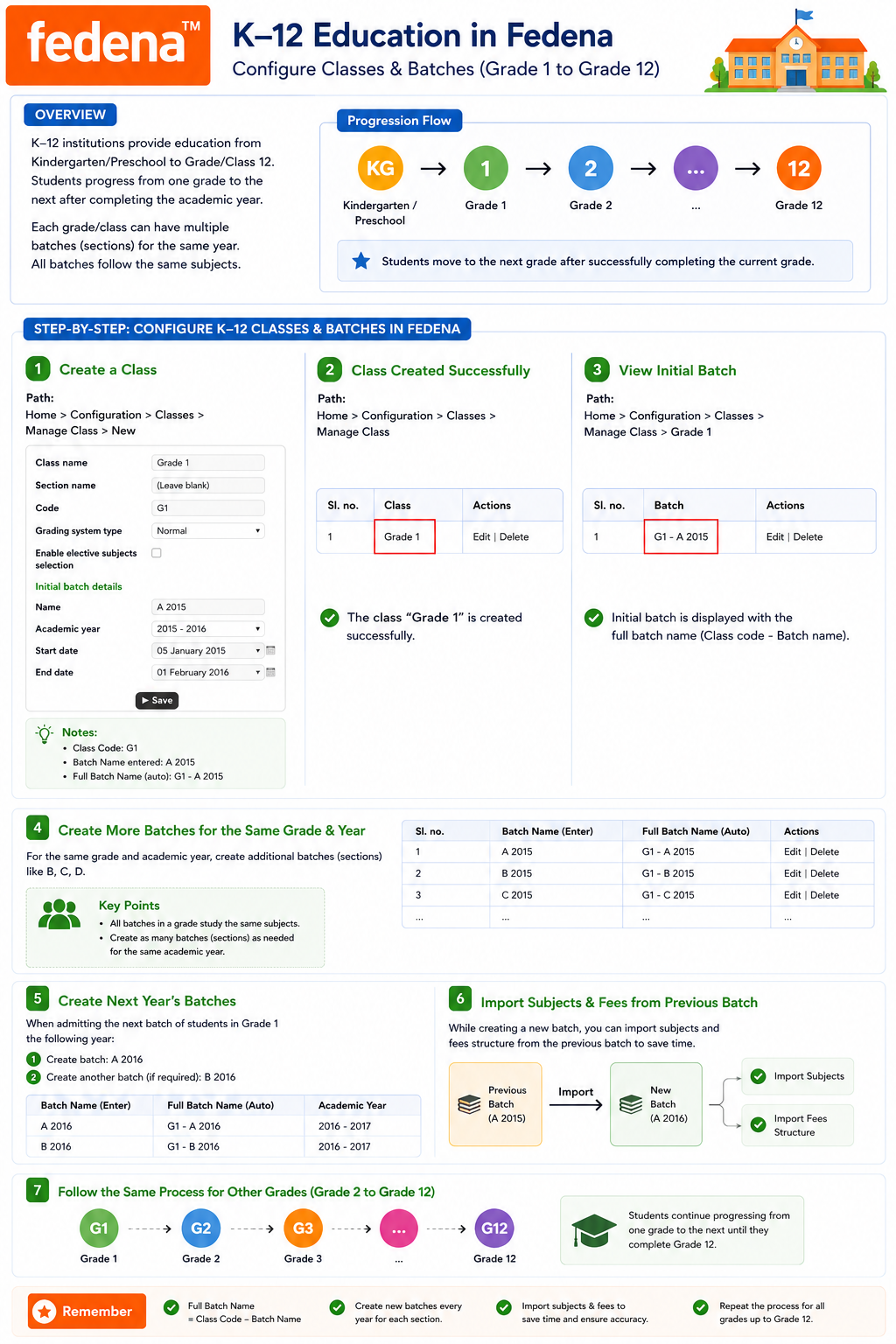
The term K–12 Education is widely used across many countries to represent the complete school education journey, beginning from Kindergarten/Preschool and continuing through Grade/Class 12. However, educational terminology and structures may differ based on regions and institutional practices.
In different institutions, these levels may also be referred to as:
- Kindergarten / Preschool / Nursery
- Primary School
- Middle School
- Secondary School
- High School
- Grade / Standard / Year / Class Level
Students generally begin their education at an early stage and progress to the next academic level after successfully completing the requirements of the current year.
For example:
- Kindergarten → Grade 1 → Grade 2 → Grade 3 → ... → Grade 12
- Year 1 → Year 2 → Year 3 → ... → Year 12
- Standard 1 → Standard 2 → Standard 3 → ... → Standard 12
Many K–12 institutions may also have multiple groups or sections within the same grade level for an academic year. These groups are commonly referred to as:
- Batch
- Section
- Division
- Intake
- Group
Examples:
- Grade 5 – Section A
- Grade 5 – Section B
- Year 8 – Group 1
- Standard 10 – Division C
Although students may be divided into multiple sections or batches, they usually follow the same curriculum, academic schedule, and subjects for that grade level.
This structured progression continues until students complete the required years of schooling and become eligible for graduation or transition to higher education.
In Fedena, institutions can configure these structures according to their own educational system and naming conventions using Courses, Batches, and Custom Words settings.
Was this article helpful?
That’s Great!
Thank you for your feedback
Sorry! We couldn't be helpful
Thank you for your feedback
Feedback sent
We appreciate your effort and will try to fix the article